
High‑Power Planar Transformer for EV DC‑DC Conversion
Electric vehicles demand compact, efficient, and reliable power conversion systems to support next-generation onboard technologies. This blog explores how Payton Planar’s custom transformer enables Microchip’s 4kW DC-DC converter to meet these challenges. Advanced planar magnetics contribute to high-efficiency EV power architectures.
Key Takeaways
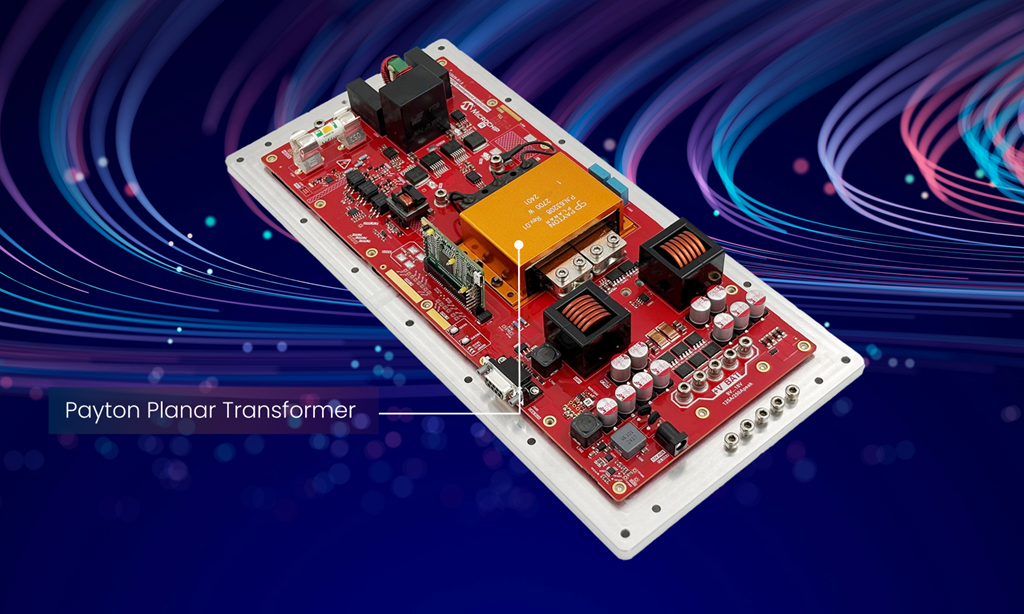 Payton Planar’s custom transformer was a critical enabler of the Microchip 4kW DC-DC demonstration platform, supporting its efficiency, size, and reliability targets. This project illustrates how advanced planar magnetics help meet the demanding requirements of modern EV power conversion systems.
Highlights include:
- A compact, high-power transformer optimized for automotive DC-DC conversion.
- Controlled parasitics and high dielectric strength supporting efficient, safe operation.
- Planar technology delivering size reduction, thermal performance, and manufacturing consistency.
- A collaborative design process ensuring alignment between magnetics and converter control strategies.
Introduction
As electric vehicle (EV) technology advances, the demand for compact, high-efficiency power conversion systems is growing rapidly. These systems must manage increasingly higher voltages, tighter space constraints, and rigorous thermal and electrical demands. Microchip Technology’s dsPIC33C 4kW DC-DC Demonstration Application is a reference design that addresses these challenges in next-generation EV on-board charging systems.
The core enabler of this platform is a custom planar transformer developed by Payton Planar. This blog explores the design objectives, technical challenges, and solutions that made this high-performance transformer a key part of Microchip’s power conversion platform
EV Power Conversion Requirements
Modern EV architecture typically operates on battery packs ranging from 400 VDC to 800 VDC, sometimes even higher. However, many critical vehicle systems, including control modules, lighting, sensors, and communication units, rely on a stable 12V supply. The DC-DC converter that bridges this voltage gap plays a vital role in overall vehicle performance and safety.
Designing such converters requires balancing several key requirements:
- High efficiency to minimize losses and reduce thermal stress.
- Compact design to fit within limited packaging spaces.
- Robust electrical isolation for compliance with automotive safety standards.
- Thermal management for reliable operation under wide temperature ranges.
- Flexible operation modes to handle diverse load and power profiles.
Microchip’s 4kW DC-DC platform meets these needs by integrating SiC MOSFETs for high-speed switching and dsPIC® Digital Signal Controllers (DSCs) for advanced control. The platform delivers peak efficiency up to 96.3%, offers multiple operation modes (including pre-charge, burst, buck, and parallel rail modes), and provides comprehensive protection features such as isolated voltage monitoring, temperature sensing, and short-circuit protection.

Fig. 1: Microchip 4kW DC-DC demonstrator featuring Payton Planar transformer
Challenges in Automotive DC-DC Converter Design
High bus voltage and 12 V auxiliary load
A key challenge in EV DC-DC converter design is managing the high-voltage bus while reliably supplying the 12 V auxiliary system. The transformer must provide precise isolation and handle rapid load transients without compromising system stability.
Thermal and packaging constraints
Automotive environments impose strict thermal and packaging constraints. Designers must ensure the transformer fits within limited space while maintaining low losses and safe temperature rise. Effective thermal management and power density optimization are critical factors.
The Role of the Transformer
The transformer in a phase-shifted full-bridge (PSFB) converter with current doubler rectification is central to achieving the desired electrical performance, thermal stability, and size objectives. In this application, the transformer had to deliver:
- High dielectric strength to ensure safety at elevated input voltages.
- Compact dimensions to support high power density.
- Precise control of leakage inductance and parasitic capacitance to enable zero-voltage switching (ZVS) and reduce EMI.
- Reliable thermal performance under continuous and peak power conditions.
Payton Planar’s custom solution addressed these challenges with a design that combines advanced planar winding technology, carefully selected materials, and extensive simulation-driven optimization.
Payton Planar’s Transformer Solution
The transformer developed for the Microchip platform features a compact and robust construction tailored for automotive DC-DC conversion. It measures just 88 x 66 x 25 mm, allowing it to fit easily within space-constrained assemblies. The primary inductance is specified at 1000 µH ±5%, with an estimated leakage inductance of approximately 7 µH, carefully optimized for the converter’s switching strategy. The transformer’s primary-to-secondary turns ratio is 17:1, supporting the voltage step-down from the high-voltage bus to the 12V auxiliary system.
Electrical isolation was a critical requirement. The transformer achieves a dielectric strength of 4 kVrms (primary to secondary plus core) and 500 VDC (secondary to core). Thermal performance was equally important, with the design validated for a maximum hot spot temperature of 130°C when mounted on a 75°C heatsink. Losses were modeled and measured at approximately 22W for 2700W peak power and 8W during 1200W continuous operation.

Fig. 2: Close-up of Payton Planar’s custom transformer
This design was the result of extensive simulation and testing. Payton’s engineering team used 3D finite element analysis to model magnetic flux, leakage paths, and thermal behavior. Materials were selected to balance core losses, saturation characteristics, and insulation robustness. Prototypes underwent full electrical and thermal validation, including dielectric strength and partial discharge testing.
Design methodology and simulation
The design process employed advanced finite element analysis (FEA) and electromagnetic simulation to optimize core geometry and winding configuration. This ensured minimal leakage inductance, balanced thermal distribution, and stable operation over a wide frequency range.
Key specifications (size, inductance, isolation, losses)
The resulting transformer achieved high efficiency (>97%), compact dimensions, and isolation up to 2.5 kV. Its inductance and parasitic parameters were tightly controlled to support zero-voltage switching (ZVS) operation, contributing to reduced switching losses and improved system reliability.
Why Planar Technology?
Planar magnetics provided several distinct advantages for this project. The layered PCB winding structure and precision assembly enable tight control of parasitic parameters such as leakage inductance and interwinding capacitance. This level of control is essential for modern converter topologies like PSFB, where switching performance and EMI compliance depend heavily on parasitic behavior.
The flat winding geometry of planar transformers also offers superior thermal performance compared to traditional wound designs. Large surface areas improve heat transfer to cooling plates or chassis, allowing higher power levels within smaller volumes without excessive temperature rise. This was key to achieving the 130°C hotspot specification required for the Microchip platform.
Moreover, planar technology enhances mechanical repeatability and manufacturing consistency, critical factors in automotive applications where tight performance tolerances and long-term reliability are mandatory. The transformer’s form factor also simplified integration into the demonstration platform’s mechanical assembly, reducing complexity in final product design.
In summary, planar magnetics provided:
- High power density in a compact form factor.
- Superior thermal management capabilities.
- Consistent parasitic performance for reliable ZVS operation.
- Mechanical robustness and easy integration.
Conclusion & Industry Outlook
The collaboration between Payton Planar and Microchip demonstrates how carefully engineered magnetics can unlock new levels of performance in automotive power systems. As EV technologies continue to advance, planar magnetics will remain a key technology for achieving the compactness, efficiency, and reliability demanded by next-generation platforms.