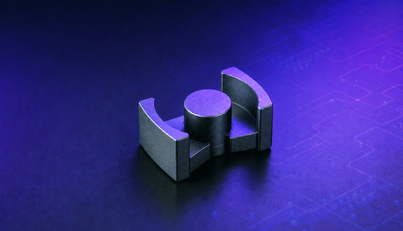
Why Planar Magnetics Excel in Harsh Environments
By: David G. Morrison, Editor, How2Power.com
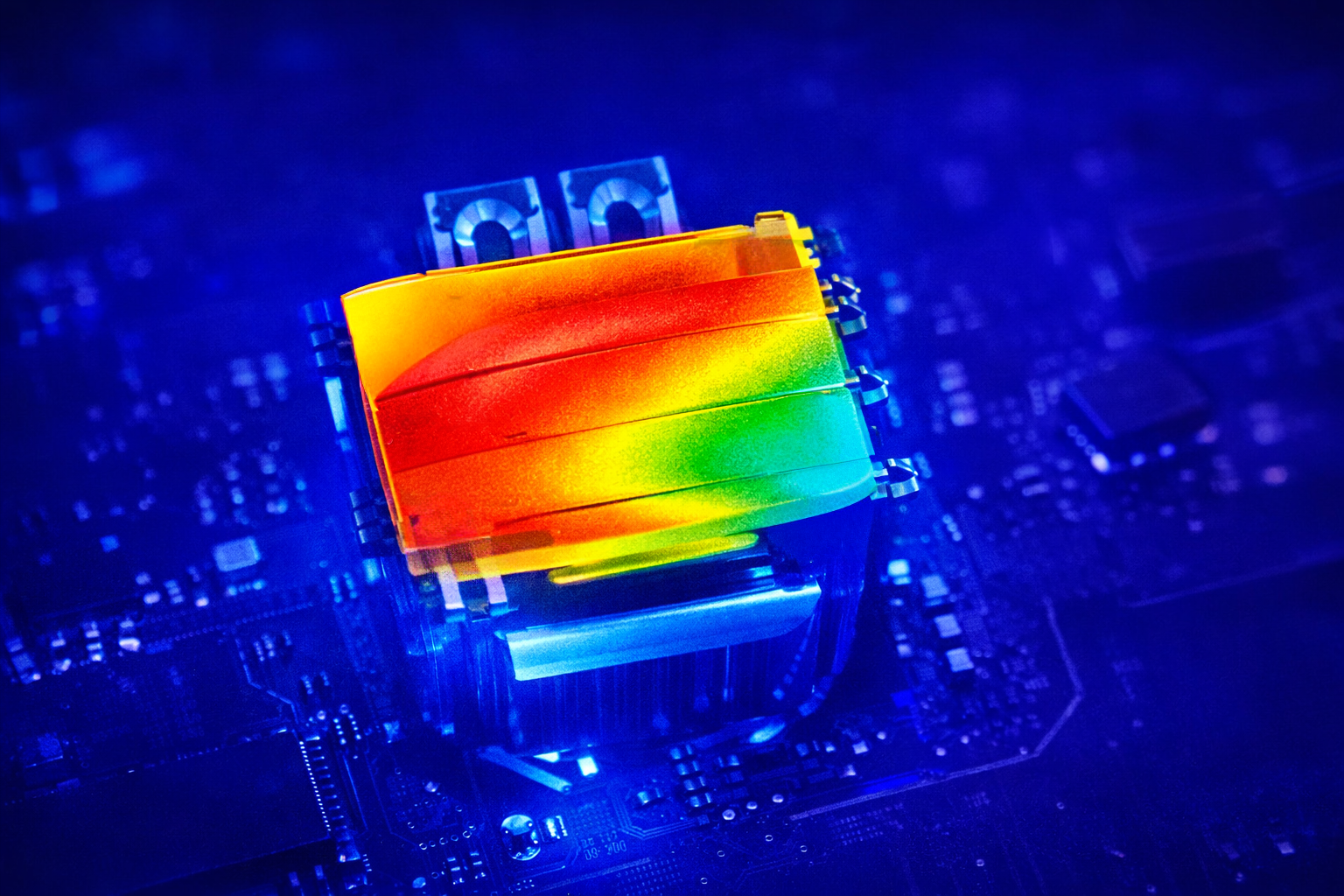 The Components for Military & Space Electronics (CMSE) conference brings together industry leaders to showcase advances in high-reliability electronics, with a focus on passive components, packaging, and rigorous qualification. At CMSE 2025, Payton Planar’s expertise in planar magnetics for harsh and space environments was a key highlight, underscoring the company’s leadership in the field.
Key Takeaways
- Compact and Reliable Design: Payton Planar’s layered construction supports compact, lightweight, and highly repeatable magnetics- making them well-suited for demanding space and military applications.
- Proven Qualification: More than 300 custom Payton designs have been qualified for space, including successful partial discharge testing up to 20 KVrms.
- Thermal and Lifetime Engineering: Proper thermal management and derating strategies are key to achieving high Mean Time Between Failure (MTBF) in harsh environments.
- Precision for Modern Electronics: Payton’s manufacturing and design processes enable precise control of leakage inductance and capacitance, supporting the requirements of today’s advanced power converter topologies.
- Comprehensive Validation: Extensive qualification, including simulation, physical testing, and compliance with industry standards, ensures every Payton transformer is ready for mission-critical deployment.
Planar Magnetics: Performance and Reliability for Space
Planar magnetics have become a preferred solution in military and space applications due to their compact size, lightweight construction, high efficiency, repeatable manufacturing, and superior performance compared to traditional wound transformers and inductors. These attributes make planar magnetic components especially well-suited for demanding environments where reliability and precision are critical.
Payton Planar’s designs demonstrate several advantages:
- Conduction Cooling Capability: Planar construction naturally supports efficient heat transfer, supporting reliable operation under high power and temperature cycling.
- Proven Track Record: With over 300 custom magnetic designs qualified for space, Payton Planar components have established a record of successful deployment, including passing stringent partial discharge tests up to 20 KVrms at detection rates down to 1 pC.
- Standards Compliance: Payton’s products consistently meet or exceed the requirements of EEE INST-002, Mil-Std-981, and Mil-STD-1580, which govern space and defense component screening.
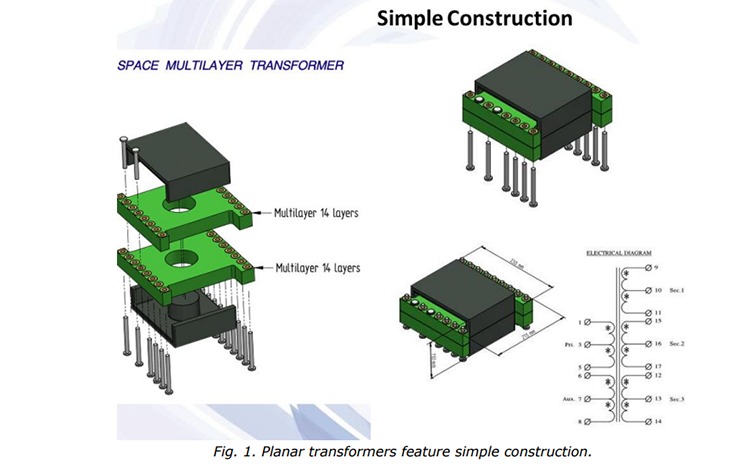
Simple, Repeatable Layered Construction
The layered design of Payton Planar’s transformers ensures consistent manufacturing quality and makes it easier to control critical electrical characteristics such as leakage inductance and capacitance. Even complex transformers with multiple primary and secondary windings can be constructed with relatively few parts, enhancing both reliability and quality assurance.
Reliability Engineering: MTBF and Thermal Management
Achieving high reliability in space environments requires careful thermal management and proper derating of each component. Payton Planar’s magnetics are engineered to stay within specified internal hotspot temperature limits, with both cooling systems and derating strategies implemented to maximize Mean Time Between Failure (MTBF).
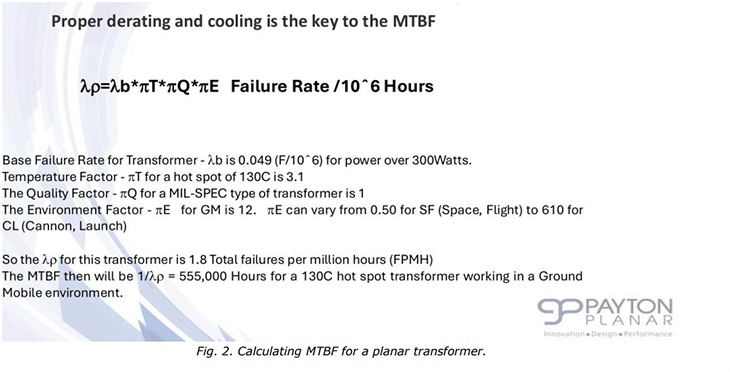
The product lifetime of planar magnetics in harsh environments can be influenced by factors such as:
- Loss of inductance over time
- Failures in multilayer boards due to thermal or moisture stress
- Failures in ferrite cores or adhesives
- Partial discharge events
By addressing these challenges through advanced materials, manufacturing controls, and detailed analysis, Payton Planar ensures robust operation in mission-critical systems.
Precision in Modern Power Electronics Design
Contemporary power electronics often require highly specific electrical parameters. In modern converter topologies, such as LLC and DAB, achieving precise leakage inductance and minimized capacitance is essential for optimal performance and efficiency. Payton Planar’s design methodologies enable:
- Controlled leakage inductance through the choice of integrated or separated winding structures
- Tight management of inter-winding capacitance by specifying winding types and insulation materials
The company’s ability to keep parasitic elements under control through its manufacturing process supports high repeatability and consistency in large-scale production.
Comprehensive Qualification, Testing, and Simulation
To guarantee the reliability of each design, Payton Planar employs a rigorous suite of qualification and testing procedures, including:
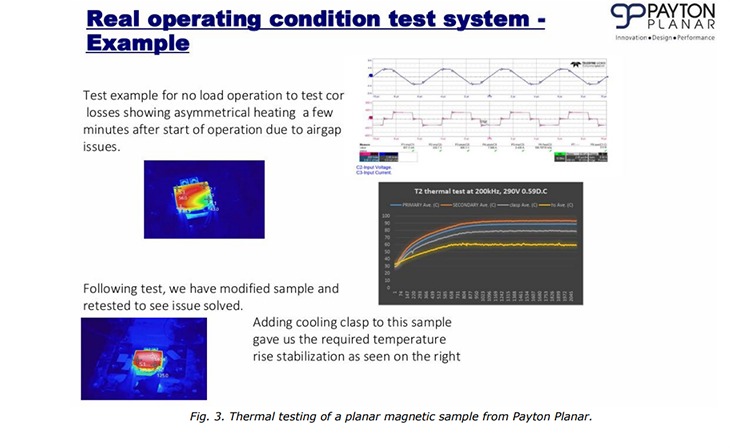
Thermal testing to identify and resolve issues related to core losses, asymmetrical heating, or cooling needs.
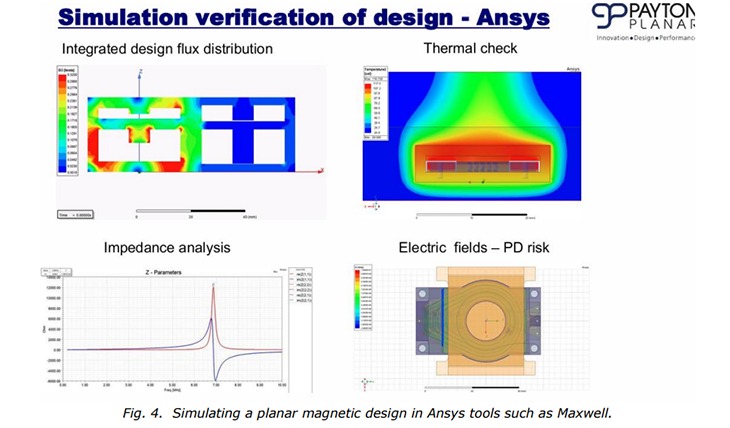
Simulation-based verification using advanced tools such as Ansys Maxwell, enabling in-depth analysis of flux distribution, thermal characteristics, impedance, and partial discharge risk.
Mechanical and electrical testing following industry standards (Mil-Std-981, Mil-STD-1580) as well as comprehensive visual and radiographic inspection and material analysis to eliminate the use of prohibited substances
These processes confirm that each Payton Planar transformer is ready for long-term, reliable operation in extreme conditions, including vibration, shock, and prolonged electrical loading.
Conclusion
With decades of proven experience and a commitment to rigorous engineering standards, Payton Planar continues to set the benchmark for planar magnetics in harsh environments. The combination of robust design, reliable layered construction, precise thermal management, and comprehensive qualification ensures that Payton Planar products remain the choice for mission-critical aerospace and defense applications worldwide.